TransSwissRun: a mythical Swiss crossing

2026 Edition, from July 25 to August 1 – Swiss National Day

ROUTE DESCRIPTION

Chargement de la carte...

From Chancy to Lake Geneva

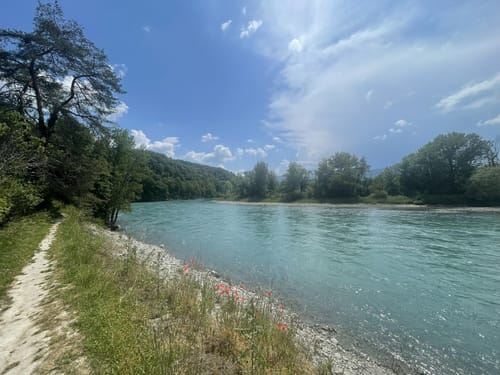
The TransSwissRun starts from Chancy, a peaceful Geneva commune, the westernmost in Switzerland, nestled on the banks of the Rhône. This river, born from the glaciers of Valais and flowing to the Mediterranean, marks the Franco-Swiss border here. It accompanies the runners' first steps in a nature reserve where silence and forest reign. On a 500-meter path, forbidden to motorized vehicles, the race opens in the intimacy of the living before returning to asphalt.

The runners cross the last vestiges of the Geneva countryside, between open fields and discreet hamlets, then cross the Rhône to reach its right bank. They follow the river to its outlet in Lake Geneva — the western end of Lake Léman. This lake, which bears the name of the city of Geneva, reflects the international stature of this city, home of peace and great international organizations.

Along Lake Léman

The quays lined with gardens and sculptures, dotted with amazed onlookers, welcome the runners in an elegant setting, before they embark on the Route de Suisse. This road runs along Lake Léman to Lausanne, punctuated by diplomatic residences and historic properties, witnesses of an aristocratic past and a cosmopolitan present.

They reach Nyon, a Roman city founded by Julius Caesar in 45 BC, whose remains still dot the parks and alleys. The race then follows the changing shores of Lake Léman to Rolle, an elegant town nicknamed "the Pearl of Lake Léman," proud of its flowered quays and its castle by the water, built in the 13th century by Count Peter II of Savoy, known as "Little Charlemagne." From there to Morges — a flowered town nicknamed "La Coquette" — terraced vineyards accompany the runners, hugging the curves of the road while the lake sparkles in the golden afternoon light. On the horizon, the Alps emerge, a promise of challenges to come.

Lausanne and the Fribourg hills

The race glides toward Lausanne, the Vaud capital perched on three hills. City of Olympism and culture, it is crossed diagonally, through the historic center and its steep alleys, offering a striking panorama of Lake Léman and the Savoyard mountains.

Then comes Oron, its castle sitting on a promontory, which the runners graze in passing, before wandering in the heart of the Fribourg hills. There, the cows sport a black and white coat — a nod, certainly fortuitous, to the colors of the cantonal flag. We then plunge toward Bulle, a medieval city and gateway to Gruyère, where cheese traditions and green pastures accompany the steps.

Jaun Pass and the Bernese Oberland

The Jaun Pass, the lowest of the five passes on the route, is nonetheless the first major alpine challenge. It connects the canton of Fribourg to that of Bern and opens onto the Simmental, home of the famous eponymous cattle breed, exported worldwide. Emblematic valley of the Bernese Oberland, its chalets with flowered balconies tell centuries of alpine life.

At Wimmis, the mountains close in. The race enters the realm of giants: Interlaken, a tourist, elegant and popular city, nestled between the lakes of Thun and Brienz, is dominated by the Eiger, Mönch and Jungfrau — stone sentinels rising to the sky. The small road that runs along the left bank of Lake Thun, deep blue, narrows at Iseltwald to become a simple path. This leads between, on the right, the Giessbach Falls — a column of water fallen from the sky, bursting in sparkling sheaves with a thunderous crash close to the steps — and on the left, the sumptuous eponymous hotel, placed there like a Belle Époque dream.

Meiringen and the Aare Gorge

A little further, shortly before Meiringen, the runners cross the Reichenbach torrent — the very one that, higher up in the mountain, supposedly carried Sherlock Holmes away in his legendary fall. At Meiringen, the Aare river bursts from the gorges where, furious and boiling, it is trapped in the mountain, as if split with an axe. Runners can cross these spectacular gorges — but only during opening hours. Otherwise, the official route takes them through a peaceful forest, until they find the Aare on the other side, just before its plunge into the gorges. It then accompanies them to Innertkirchen, at the foot of the Susten Pass.

The Susten Pass and the Reuss Valley

The Susten Pass, inaugurated in 1945, is a masterpiece of alpine engineering. It winds between glaciers and waterfalls, offering vertiginous views. Once the pass is crossed, the runners reach the Reuss Valley — a furious and undulating snake, steel-gray in the Schöllenen Gorges — deep heart of primitive Switzerland, but also strategic crossroads since Antiquity for the transport of goods and people from south to north and vice versa. Its legends, such as that of the Devil's Bridge, still standing, which spans the gorges, still resonate in memories.

Andermatt and the Oberalp Pass

At Andermatt, at the foot of the Gotthard Massif — Europe's true water tower and neuralgic crossroads since Roman times — the runners might encounter President Adolf Ogi, former Federal Councillor for thirteen years and twice President of the Swiss Confederation, who might shout his famous "That's fantastic!" as encouragement. They could also greet Bernhard Russi, living ski legend, Olympic and world champion, local hero. It is from this high alpine place that they begin the ascent of the Oberalp Pass, natural border between the cantons of Uri and Graubünden, where the Rhine rises before rushing to the North Sea.

The Albula Valley

The anterior Rhine valley, which near Glion takes on Colorado airs, leads the runners to Bonaduz. They then cross the posterior Rhine valley — the Domleschg — before climbing the wild Albula valley, traversed by the small red trains of the Rhaetian Railway and the Glacier Express — the slowest express train in the world! This spectacular line, a UNESCO World Heritage Site, crosses the valley many times on daring viaducts, connected by curved tunnels carved into the mountain.

After the magnificent village of Bergün, which is reached via the Igl Crap, the valley leading to the Albula Pass becomes majestic and harsh, especially in its upper part, where the rocks and colors evoke a Martian landscape. On the other side of the pass, nestled in the valley, the village with the singular name of La Punt Chamues-ch — followed a little further by Zuoz and S-chanf — was the official residence of the recently deceased Milanese couturier Giorgio Armani.

The Engadine and the National Park

The descent to the Engadine begins: in its vast and luminous valley, the Inn — En in Romansh —, an important tributary of the Danube that will end in the Black Sea, borders villages with massive and comfortable houses, with facades decorated with sgraffiti, cameos or multicolored paintings, vibrant witnesses of Romansh identity.

At Zernez, the runners enter the Swiss National Park, the oldest in the Alps, founded in 1914. Sanctuary of biodiversity, it demands respect for silence and nature. The Ofen Pass, last pass, offers a striking view of Val Müstair, gentle and welcoming, where the Benedictine monastery of St. John, founded by Charlemagne nearly thirteen centuries ago and UNESCO-listed, watches over arrivals.

Arrival in Müstair

Finally, after crossing the magnificent village of Santa Maria: Müstair! At the Italian border, the race ends with a forest path, on the banks of the Rom river — as it had begun. There, Switzerland fades into the immensity of the eastern space.

508 kilometers, 10,000 meters of elevation gain: a crossing of body and soul.

The TransSwissRun is not just a sporting challenge — it is a geographic, historical and human odyssey. A vibrant tribute to diversity and beauty, through a country... what am I saying, a continent, a world, a universe, shaped by nature and by men, in their struggles and their passions. Here, in the heart of Europe, fights and battles were fought; here alliances and misalliances were woven, tied then undone over the centuries. And it is here, on this land born from a past of conflicts, that a nation was forged that chose the path of dialogue, active neutrality and hospitality. It embodies a tradition of peace based on memory, mediation and respect for dignity.

For the Trans-Swiss-Run Association,

Bière, October 20, 2025

An odyssey from west to east

The TransSwissRun is a non-stop running race connecting the two extremities of the country: from the Franco-Swiss border post 1.5 at Chancy (Geneva), on the banks of the Rhône, to Müstair (Grisons), on the Italian border, on the banks of the Rom river.

The route

  • • 508 km distance
  • • More than 10,500 m elevation gain
  • • 93 municipalities crossed
  • • 6 cantons
  • • 5 alpine passes (4 above 2000 m)
  • • 4 river basins
  • • 3 linguistic regions

An immersion in authentic Switzerland

Each step immerses you in a postcard setting: sparkling lakes, deep forests, peaceful valleys, alpine villages... The route crosses French, Swiss German and Romansh. More than just a route, it's a dive into the Swiss soul.

An endurance race... and character

172h
3 km/h
GPS

The TSR is not a walk in the park. It's a demanding adventure, without official refreshments, with isolated sections, significant elevation changes and sometimes unpredictable conditions.

Autonomy, preparation and support are essential.